Cleaning How-tos Low effort15 min
Clear a sink full of dishes in 15 minutes, in a fixed order
A fixed order for a sink full of dishes: bin, rubbish, stack, soak, wash. One 15-minute timer, so there is nothing to decide.
What do I need before I start?
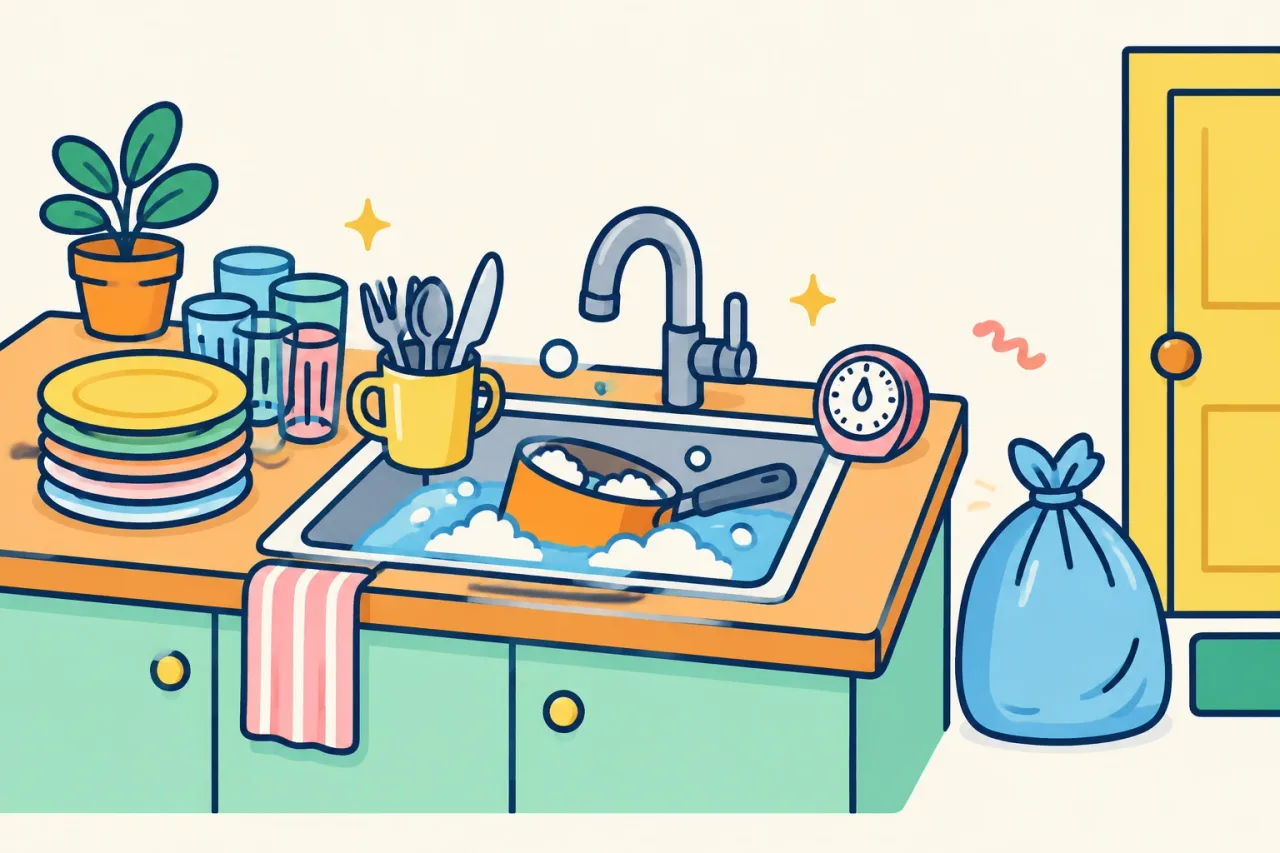
You need a timer, one bin bag, a mug, washing-up liquid and hot water. Gather them before you start the clock, so all 15 minutes go on the dishes.
- A timer set to 15 minutes. Any phone timer works.
- One bin bag, for when the bin is full.
- One mug, to hold the cutlery.
- Washing-up liquid and a tap that runs hot.
- A clear patch of worktop, plus the hob, for stacking.
You do not need to tidy first. Many people with ADHD say that extra prep is where a job stalls, so keep the kit short and leave it by the sink.
What is the order?
Do bin, rubbish, stack, soak, wash, in that order, on one 15-minute timer that you set before you start. Set it once and let it run to the end. Do not restart it or add a second one. The times below are marks on that one clock.
- Minutes 0 to 2: bin and rubbish.
- Minutes 2 to 5: stack.
- Minutes 5 to 6: soak.
- Minutes 6 to 15: wash.
There is nothing to decide. When one step ends, you already know the next. If your timer counts down, the marks come at 13, 10 and 9 minutes left.
What do I do in the first two minutes?
Scrape the plates into the bin, then clear the rubbish, such as wrappers, cans and packaging. Take it in this order.
- Scrape each plate and bowl into the bin. Do not rinse anything yet.
- Pick up wrappers, cans and packaging from the sink and the worktop around it.
- Use one bin bag if the bin is full.
- Tie the bag and leave it by the door.
Taking the bag out can wait until the timer is done. A trip to the outside bin is a different job, and it is easy to lose the clock on it. Two minutes is short. If you are not finished at the mark, move on anyway.
How do I stack and soak?
Stack for three minutes, then soak for one. Stacking means sorting the pile into groups, so the sink is clear enough to wash in.
For the three minutes of stacking:
- Make one group for glasses.
- Put the cutlery in the mug.
- Pile the plates.
- Put the pans on the hob.
For the one minute of soaking, fill the worst pan with hot water and a squirt of washing-up liquid, then leave it alone. Pick the pan with the most stuck-on food. It does the work while you move on, so do not scrub it now.
How do I wash with the time left?
Wash for the last nine minutes, with the same timer still running. Go in this order: glasses, cutlery, plates, then pans.
- Glasses first, while the water is cleanest.
- Cutlery next. Tip it out of the mug and wash it in one go.
- Plates after that.
- Pans last, ending with the one that soaked.
When the timer goes off, stop, even if the pile is not gone. What is left is already stacked, and that is a good place to leave it. Drying can wait. Stopping on time is part of the plan, not a failure of it.
What if it goes wrong or my energy runs out?
If your energy runs out, do the first two minutes and stop. That means scraping the plates and clearing the rubbish. The sink will already look different. Stuck is not lazy.
Other things that go wrong:
- The bin bag fills up. Tie it, leave it by the door and start a new one.
- The water goes cold. Run the tap hot again and carry on.
- The timer ends mid-plate. Finish the plate in your hand, then stop.
- The washing feels like too much. Wash the glasses only, then stop.
None of these means you have done it wrong. Leave the rest stacked and come back to it.
What mistakes should I avoid?
The most common mistakes are changing the order, restarting the timer and carrying on past the end. Each one makes the job longer and harder to finish.
- Washing before you stack. You end up working around a pile.
- Starting with the pans. They are slow, so they eat the clock before the quick wins.
- Restarting the timer or adding a second one. That turns 15 minutes into an open-ended job.
- Taking the rubbish out while the timer runs.
- Carrying on after the timer ends. Stopping on time makes the next go easier to start.
- Judging a half-clear sink. It is still clearer than a full one.
How do I make it easier next time?
Leave the sink stacked and the kit by the tap, and next time starts with less to do. Whatever is left when the timer ends is already sorted, and the worst pan has been soaking.
A few small habits help:
- Scrape plates into the bin when you finish eating. That is the two-minute step done early.
- Keep a bin bag where you can reach it.
- Keep the washing-up liquid by the sink, not in a cupboard.
- Use the same 15-minute timer and the same order each time. A familiar order means less to decide.
You do not need a special app for this. A phone timer is enough.
Frequently asked questions
How long does it take to wash a sink full of dishes?
This plan gives it 15 minutes. A very full sink may not be finished by then, so stop when the timer ends. Anything left is already stacked and soaking, which makes the next go easier. If you want to know why a timer helps, read [why timers help ADHD brains get moving](/guides/why-timers-work).
What if I cannot face the sink at all?
Do only the first two minutes: scrape the plates and clear the rubbish. You can stop after that. If starting is the hard part, try [how to clean when you are too overwhelmed to start](/guides/how-to-clean-when-overwhelmed).
Is there an app that can run the timer?
Any phone timer works. We make Panic Clean, which has timers of 1 to 15 minutes with a beep and vibration every minute. It is on iOS and Android and only does cleaning. You can read more on its [Panic Clean page](/tools/panic-clean).
Should I wash the pans first?
No. In this plan you wash glasses, cutlery, plates, then pans. Only the worst pan is soaked early, for one minute, so it is easier by the time you reach it.
Where do the dishes go if there is no room to stack?
Use the worktop and the hob. Glasses go in one group, cutlery goes in a mug, plates go in one pile and pans go on the hob. If space is tight, make the plate pile taller rather than wider.