Routines How-tos Low effort10 min
The ten-minute reset: a daily tidy that fits a bad day
A ten-minute daily tidy in one fixed order: rubbish, dishes, surfaces, then stop. Small enough to do on a day when you have nothing left.

What do you need before you start?
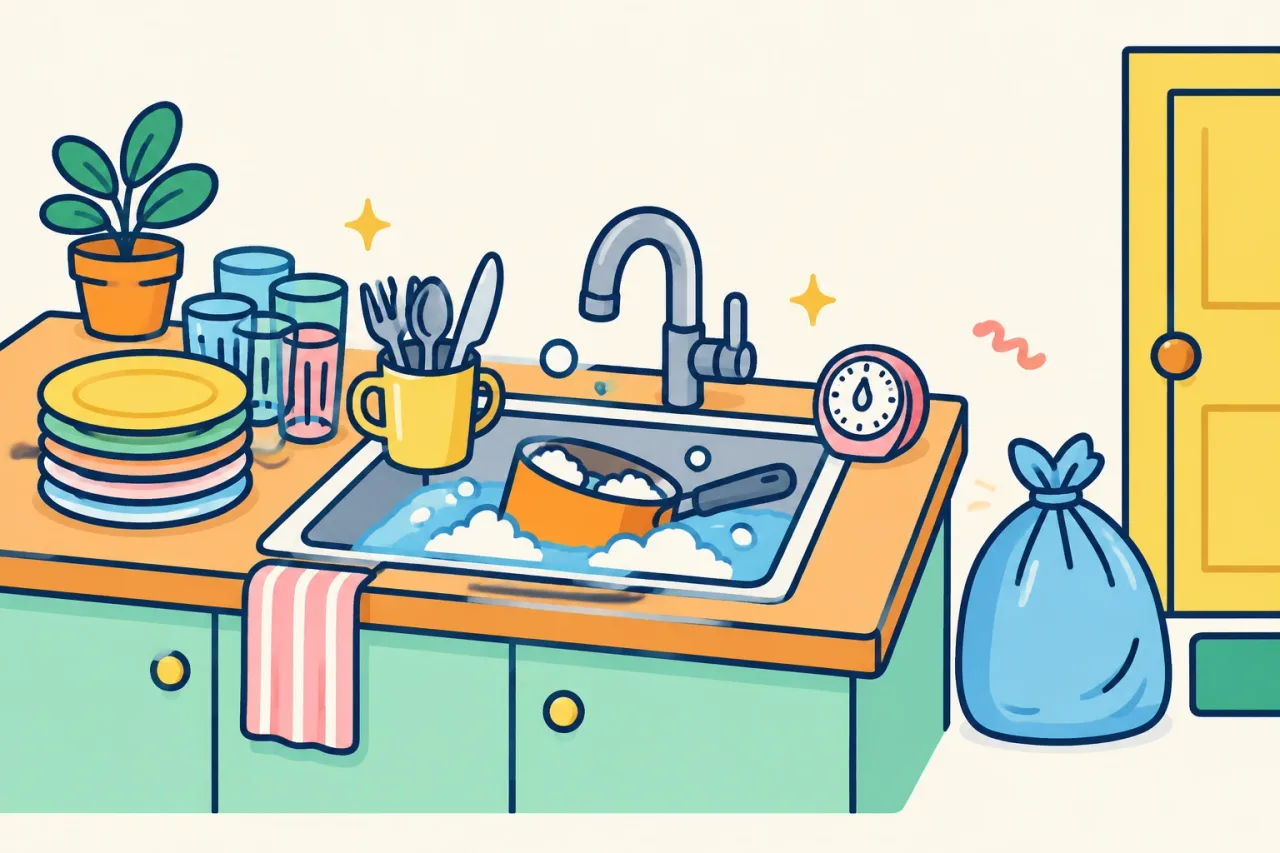
You need a timer, one bin bag and a cloth. Keep them where you will see them, so you never have to hunt.
- A timer. Your phone is fine. You will set it to 10 minutes.
- One bin bag, any size.
- A cloth or sponge for the sink and surfaces.
- Washing-up liquid, if you wash by hand.
- One room. The kitchen is a good start, or wherever the mess bothers you most.
Choose the room before the day gets hard. Many people with ADHD say that deciding in the moment is the part that stops them. If you decide once, the reset has fewer places to stall.
When should you do the reset?
Do it at the same time each day, tied to something you already do. That link is called an anchor. It saves you from having to remember.
Good anchors are right after dinner, or when the kettle goes on. Pick one. Not three. Any time of day works, so use the one that suits your life, not someone else’s morning routine.
Choose an anchor that still happens on bad days. If it only happens when you feel well, the reset will vanish exactly when you need it. You eat, you boil the kettle, you come home. Those make steady anchors.
Say the anchor out loud once: “After dinner, I do ten minutes.” It sounds small. It does the job.
What are the steps, in order?
Start the timer for 10 minutes, then work through three steps in this order: rubbish, dishes, surfaces.
- Rubbish. Walk the room once with the bin bag. Pick up wrappers, packaging, empty cups and anything clearly bin-bound. Tie the bag when the room is done or the bag is full.
- Dishes. Carry every cup and plate to the sink. Wash them or load the dishwasher. Leave pans that need a soak.
- Surfaces. Clear one surface at a time, starting with the one you see first. Put each thing back where it lives, then wipe the surface.
If something has no home, put it in one spot and deal with it another day. Do not stop to solve it now. When the timer goes, stop.
What if the timer ends mid-task?
Stop anyway. Put the cloth down where it is and walk away.
This is the part that feels wrong, and it is the part that keeps the reset safe. If you know it always ends at ten minutes, starting costs very little. If it sometimes grows into an hour, starting gets scarier.
Tomorrow’s reset picks up from wherever things are. You do not need to finish today’s surface first. The order stays the same: rubbish, dishes, surfaces.
If you finish all three steps before the timer, you can stop early. You do not need to add another room or another round. Ten minutes is the most you owe the reset.
What should you do on a bad day?
On a bad day, do two minutes of rubbish and call it done. Two minutes counts.
Set the timer for two minutes. Pick up the bin bag. Begin at step 1, rubbish, and gather only what is clearly rubbish. When the timer goes, stop. The reset has happened.
Keeping the habit alive matters more than the result. A room that looks the same after two minutes still has a reset streak behind it, and that is easier to build on than a gap.
If you have energy left, carry on to dishes, up to the ten-minute mark. If you do not, stop. Being unable to start is not a character flaw. Stuck is not lazy.
Which mistakes make the reset harder?
Five common mistakes make the reset harder, and each has a simple fix.
- Doing two rooms. Stay in one room. The second room can have its own day.
- Changing the order. Keep rubbish, dishes, surfaces. Fewer choices means fewer stalls.
- Carrying on past the timer. Stop at ten minutes, even when you are mid-task.
- Waiting until you feel up to it. Use the anchor instead. Feeling ready often does not arrive.
- Counting a short reset as a failure. Two minutes on a bad day is a full reset, not a poor attempt.
If you notice yourself doing one of these, nothing has gone wrong. Go back to the three steps next time.
How can you make it easier next time?
Make the next reset easier by leaving the kit ready. Put the bin bag and cloth in the room you picked, so you do not have to find them.
Finish the ten minutes with the timer still set up for tomorrow. Write your room and your anchor on a note if it helps.
A phone timer is enough for this. If you want an app, we make Panic Clean, and it only does cleaning. It has timers of 1 to 15 minutes per zone with a beep and vibration every minute. It is on iOS and Android, free to start with some paid features. See Panic Clean for details.
Frequently asked questions
How do I keep my room clean with ADHD?
A short daily reset in a fixed order works better for most people than a big weekly clean. The ten-minute reset is one version: ten minutes, one room, rubbish, dishes, surfaces, then stop. Many people with ADHD say a fixed order means fewer decisions to get stuck on.
How long should a daily tidy take?
Ten minutes is enough for the full reset. On a bad day, two minutes of rubbish still counts. Stop when the timer ends, even if you are mid-task.
What if I miss a day?
Do the next reset as normal. You do not need to make up the missed time or clean twice as long. Start with rubbish, then dishes, then surfaces, and stop at ten minutes.
Does it matter which room I pick?
Pick one room per reset, and choose it before the day gets hard. The kitchen is a good start because the dishes step happens right there. In another room, carry any cups and plates to the sink, then move on.
Do I need an app for the ten-minute reset?
No. A timer on your phone is enough. If you want an app, we make Panic Clean, which only does cleaning and has timers of 1 to 15 minutes per zone.